
You are in: Home, then Guides, then The 30-day rule.
Request Medical Records Under HIPAA
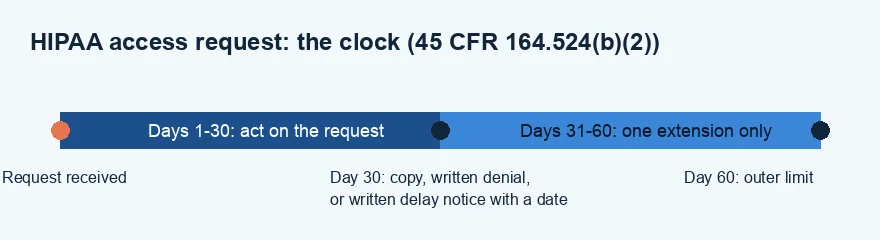
A HIPAA-covered provider must act on your access request no later than 30 days after it receives it. It can take one extension of up to 30 more days, but only by telling you in writing, inside the first 30 days, why it needs more time and the date it will finish. Fees for your own copy are limited to cost.
Where people lose time
The federal deadline is generous on paper, yet many patients wait far longer than 60 days. In almost every case the request itself is the problem, not the law. These are the slips we see most often.
- Sending an authorization when you meant an access request. A HIPAA authorization (45 CFR 164.508) is the form that lets a provider release records to someone else. If the copy is for you, say so: "I am requesting access to my records under 45 CFR 164.524. Please send the copy to me." Many hospital authorization forms can be used either way, but the box you tick for the recipient decides which rules apply.
- Not putting it in writing. A provider may require written requests as long as it tells patients about that requirement (45 CFR 164.524(b)(1)). A phone call starts nothing you can later prove.
- Leaving out dates of service. "All records" from a hospital you have used for twenty years can mean thousands of pages, and a records office may come back with questions. Give a date range and name the visits that matter.
- Forgetting the format. If the records are kept electronically and you ask for an electronic copy, the provider must give you one, in the format you ask for if it can readily produce it, or in another readable electronic format you agree on (45 CFR 164.524(c)(2)(ii)). If you do not ask, you may get paper.
- Not keeping a copy of what you sent. Without the request and a delivery record, you cannot show when the 30 days began.
Proving when the clock started for your medical records request
The 30 days run from the provider's receipt of the request, not from the date you signed it. If you ever need to complain, to the provider's privacy office or to the U.S. Department of Health and Human Services, you will want to show three things: what you asked for, when it arrived, and what (if anything) came back. Keep:
- a copy of the signed request and any form the provider required;
- a fax transmission report, a portal confirmation screen, an email with the attachment, or a mail tracking record that shows delivery;
- any letter giving a reason for delay, and the date it promised;
- a note of each follow-up call: date, the name or title of the person, and what they said.
A complaint to HHS must be in writing, must name the provider and describe the problem, and must be filed within 180 days of when you knew or should have known about it, unless HHS waives the limit for good cause (45 CFR 160.306(b)). Good records make that complaint short and specific.
What the regulation actually says
The right of access lives in one section of the HIPAA Privacy Rule, 45 CFR 164.524. In plain English:
- The right. You may inspect and get a copy of health information about you held in a provider's or health plan's "designated record set", for as long as it is kept there. Two things are carved out: psychotherapy notes, and material compiled for a lawsuit or other legal proceeding (164.524(a)(1)).
- The deadline. The provider must act within 30 days of receiving the request: either give access or send a written denial (164.524(b)(2)(i)).
- The one extension. If it cannot finish, it may extend once, by no more than 30 days, and only if it sends you, within the first 30 days, a written statement of the reasons and the date it will act (164.524(b)(2)(ii)).
- The format. Your requested form and format if readily producible; electronic records on request must be supplied electronically (164.524(c)(2)).
- Sending it elsewhere. You can direct the provider, in a signed written request that names the person and where to send it, to transmit the copy to someone else (164.524(c)(3)(ii)). A federal court has limited how far that applies; see the fee section below.
- Denials. Some denials can be reviewed by a licensed professional who took no part in the original decision; a denial must be in plain language, give the reason, explain any review right and say how to complain (164.524(a)(3)-(4), (d)).
| Question | Federal answer | Citation |
|---|---|---|
| Who has the right? | The individual, or a personal representative treated as the individual | 45 CFR 164.524(a); 164.502(g) |
| Must the request be written? | Only if the provider requires it and has told you so | 164.524(b)(1) |
| Deadline to act | 30 days from receipt | 164.524(b)(2)(i) |
| Extension | One, up to 30 days, with a written reason and date given inside the first 30 | 164.524(b)(2)(ii) |
| Electronic copy | Required on request if the record is kept electronically | 164.524(c)(2)(ii) |
| Fees for your own copy | Cost-based: labor for copying, supplies, postage, agreed summary | 164.524(c)(4) |
| Excluded material | Psychotherapy notes; material compiled for legal proceedings | 164.524(a)(1) |
| Complaint deadline (HHS) | 180 days from when you knew or should have known | 160.306(b)(3) |
Text read on the electronic Code of Federal Regulations (ecfr.gov), current version, on November 13, 2026. A 2021 federal proposal to cut the deadline to 15 days was never adopted; the current text still says 30.
What it costs and how long it really takes for your medical records request
Your own copy. When the copy goes to you, a HIPAA-covered provider may charge only a reasonable, cost-based fee built from four items: labor for copying, supplies (paper, or a disc or drive if you asked for portable media), postage if you asked for mailing, and preparing a summary or explanation if you agreed to one in advance (164.524(c)(4)). A search or retrieval fee is not on that list. Some state laws allow higher charges; for a patient's own request the federal limit still controls. Georgia's Department of Community Health says this directly in its notice on state retrieval rates: state rates "should not be applied when individuals request records for themselves."
Copies sent to someone else. In Ciox Health, LLC v. Azar (D.D.C., decided January 23, 2020), the court vacated HHS's 2016 guidance to the extent it applied the patient rate to third-party directives, and vacated part of the 2013 rule that stretched the directive beyond electronic copies of electronic health records. The practical result: when your records go to a lawyer, insurer or anyone other than you, the provider can charge up to whatever your state's copy-fee law allows. Our state-by-state fee guide lists the figures we have verified.
Timing. Thirty days is a ceiling, not a target. Patient portals often release a summary much faster, but a portal rarely holds the whole chart; imaging, older admissions and scanned outside records usually need a formal request. Some states set a shorter deadline of their own. Arizona, for example, requires access or copies promptly and generally within seven business days of a written request (A.R.S. 12-2293(A)), with 10 or 15 business days for a patient's request for upcoming treatment and 30 calendar days for other purposes, including litigation (12-2293(E)), and Illinois law sets 30 days with a hard stop at 60 (735 ILCS 5/8-2001(e)). Where a state is stricter, a provider has to meet both.
Who must follow the rule, and for whom
The access rule binds HIPAA "covered entities": health plans, health care clearinghouses and health care providers that conduct standard electronic transactions, which in practice means nearly every hospital and most doctors' offices. It does not bind a school nurse's records held by a school, which are education records under federal education privacy law, or an employer's personnel file, both of which sit outside "protected health information" (45 CFR 160.103).
The person entitled to access is you, or a personal representative the provider must treat as you:
- for an adult or emancipated minor, someone with legal authority to make health care decisions for them (164.502(g)(2));
- for a minor, usually a parent or guardian, with exceptions where the minor lawfully consented to the care (164.502(g)(3)); see records for a child or dependent;
- for someone who has died, the executor, administrator or other person with authority over the estate (164.502(g)(4)); see a deceased relative's records.
HIPAA's protections continue for 50 years after death (164.502(f)).
Missed deadline? Write once more, quoting 45 CFR 164.524(b)(2), the date the provider received your request and the date the 30 days ran out. Address it to the privacy officer as well as the records office. If nothing changes, the denial letter rules require the provider to tell you how to complain to it and to HHS. If you would like the drafting and the chasing done for you, order records-request help.
Rather have someone prepare, send and follow up the request for you?
Start a records request